
In this article:
- Is your shared inbox silently draining your team's productivity and revenue?
- The Hidden Cost of Your 'info@' Inbox
- How SME Email Triage Automation Works (Without the Complexity)
- Three Steps to Direct Leads Into Your CRM
- Calculating the Value: Why Manual Sorting is a Growth Bottleneck
Is your shared inbox silently draining your team's productivity and revenue?
For many South African SME owners, the 'info@' or 'sales@' inbox is less of a lead generator and more of a black hole where opportunities go to wait—and eventually, vanish. If your team is manually reading, tagging, and forwarding emails every day, you are losing money. Implementing SME email triage automation changes the trajectory of your operations by ensuring that every incoming inquiry is routed to the right person or system without a single human touch. When your communication channel becomes a bottleneck, your growth stalls.
In this article, we explore the costs of managing a shared inbox manually and how modern tools can turn that chaos into a streamlined engine for your business. We break down how automated triage functions, outline a three-step process for syncing your inbox with your CRM, and provide a framework for calculating exactly how much revenue you are currently leaving on the table due to manual sorting. By the end, you will understand how GrowthStart can help you reclaim your inbox as a high-performance asset rather than an administrative burden.
The Hidden Cost of Your 'info@' Inbox
For many SMEs, the shared inbox is where revenue goes to stagnate. When your team relies on manual sorting to manage high volumes of inquiries, you are paying your most valuable staff members to act as digital clerks. In the competitive South African business landscape, every minute an email sits unread in an info@ or sales@ account, the likelihood of that lead cooling off increases. Research from McKinsey suggests that business process automation can deliver a 5.8x ROI within 14 months, yet many firms continue to bleed value by manually categorizing messages.
The financial toll of manual shared inbox management is often invisible until you calculate the cost per interaction. Moving from a human-handled process—which can cost between $6 and $8 per email—to an automated system reduces that figure to just pennies. For a small business with 5–25 employees, failing to automate means losing between $30,000 and $80,000 in annual value through missed follow-ups and delayed response times. To stop this leakage, you first need a stable digital foundation, which often begins by ensuring your email hosting and domain infrastructure is robust enough to handle high-frequency automated triggers.
How SME Email Triage Automation Works (Without the Complexity)
Implementing SME email triage automation does not require a dedicated software engineering team or a massive technical overhaul. At its core, the process involves a rule-based engine that acts as a gatekeeper for your inbox. Instead of a human opening every email, an automation layer inspects the metadata and body content of incoming messages the moment they arrive.
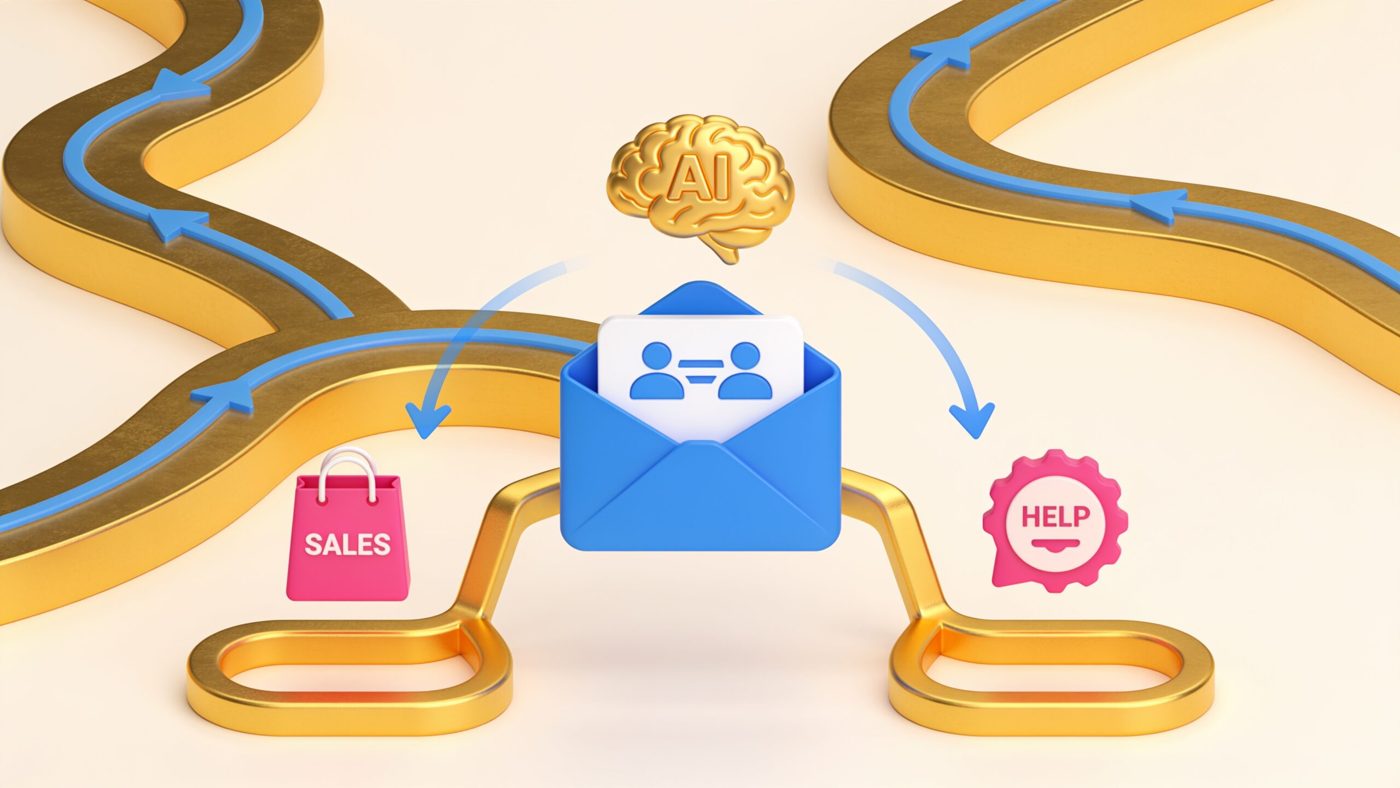
By setting up a streamlined workflow, you can categorize inquiries based on intent without human intervention. The system works by scanning for specific keywords and context, then executing the following logic:
- Lead Identification: If the email contains words like "quote," "pricing," or "proposal," the system flags it as a sales inquiry.
- Support Routing: If the email includes keywords like "error," "broken," or "login," it is routed directly to your support ticketing platform.
- Spam Filtering: General marketing noise or unsolicited outreach is moved to a low-priority folder, ensuring your team only sees actionable messages.
- CRM Sync: Key data, such as sender contact details and inquiry intent, is extracted and pushed into your CRM, creating a unified record.
By shifting your operations toward this automated model, you move away from acting as a digital sorting office and toward a focus on high-value activity: closing deals and resolving complex client issues. This approach provides your sales team with the necessary context to respond instantly, giving you a distinct competitive advantage.
Three Steps to Direct Leads Into Your CRM
Transitioning from a chaotic inbox to a streamlined pipeline is more achievable than most SME owners realize. To start implementing SME email triage automation, you only need three distinct phases to ensure your data flows accurately from your inbox to your sales dashboard:
- Parsing and Classification: Use an automation tool like n8n or Make to monitor your inbox. The system scans incoming mail and utilizes natural language processing to detect intent. If an email contains keywords like "pricing," "quote," or "demo," the system flags it as a high-priority sales lead.
- Data Extraction: Once categorized, the automation script pulls specific data points—sender name, company, and phone number—directly from the body of the email. This eliminates the need for manual copy-pasting.
- CRM Syncing: The extracted data is automatically pushed into your CRM via API. If you need a reliable foundation for these tools, ensure your business infrastructure is stable by choosing a robust provider. By mapping these fields, you ensure your sales reps receive an instant notification containing all the context needed to start a conversation immediately.
Calculating the Value: Why Manual Sorting is a Growth Bottleneck
The financial drain of manual inbox management is often invisible until you calculate the cost of lost time. According to research from Optimum Web, moving from human-led sorting to automated workflows can reduce the cost per interaction from $6–$8 down to just pennies. For a typical small business in the South African market, this efficiency gain is transformative.
When a lead sits in a general inbox for three hours waiting to be seen, the probability of them engaging with a competitor spikes. By automating this process, you stop leads from going cold, which can recover between $30,000 and $80,000 in annual value for businesses with 5–25 employees. This recovered capital is about recapturing revenue that is currently falling through the cracks.
Beyond lead management, you should also consider how other parts of your business can benefit from these efficiencies. Remember, your team’s value lies in their ability to solve complex problems and close deals—not in acting as a digital sorting office.
We recognize that automation is a powerful catalyst for growth, but it is not a silver bullet for every business at every stage. If your team is still refining its internal processes or lacks a structured CRM, investing in sophisticated routing tools may be premature. However, for SMEs ready to scale, the ROI of optimizing your inbox is undeniable.
Book a free consultation and we'll map out what to automate first — no jargon, no obligation.
Ready to Take the Next Step?
Book a free consultation and we'll map out what to automate first — no jargon, no obligation.
Get in touch with GrowthStart — no obligation, no jargon. Just a straightforward conversation about what automation can do for your business.