
In this article:
- Why Supplier Invoice OCR Xero n8n South Africa Workflows Matter
- The Hidden Cost of Manual Supplier Invoice Entry for South African Operations
- How n8n and OCR Automate Email Receipt Parsing Directly into Xero
- Step-by-Step Architecture: Ingestion, Extraction, Validation, and Accounting Post
- Quantifiable Business Outcomes: Admin Hours Saved and Tax Compliance Improvements
Why Supplier Invoice OCR Xero n8n South Africa Workflows Matter
South African operations leads and finance administrators spend dozens of hours every month manually retyping PDF supplier invoices into accounting software. Implementing a streamlined system for supplier invoice ocr xero n8n south africa eliminates routine data entry, cuts processing costs, and speeds up vendor reconciliations without requiring expensive software subscriptions. By extracting line-item data directly from incoming email receipts and posting validated figures straight into your general ledger, GrowthStart enables high-volume, cost-conscious businesses to modernise their accounts payable workflows while keeping overhead low.
In this article, we outline how local companies can build a reliable, automated back-office pipeline. We begin by examining the hidden cost of manual supplier invoice entry for South African operations and where human error typically drains cash flow. Next, we explain how n8n and OCR automate email receipt parsing directly into Xero, followed by a step-by-step architecture covering document ingestion, data extraction, validation, and accounting posts. Finally, we review the quantifiable business outcomes you can expect, focusing on administrative hours saved and tax compliance improvements.
The Hidden Cost of Manual Supplier Invoice Entry for South African Operations
Manual accounts payable processes cap operational throughput, inflate overhead, and increase cash flow risks through missed input VAT claims and delayed vendor settlements. When finance administrators spend hours rekeying invoice data into accounting software, business growth directly increases administrative headcount rather than profitability.
South African SME operations leads and finance teams face a constant influx of PDF supplier invoices, delivery slips, and emailed receipts. Capturing critical line items—such as vendor names, invoice dates, purchase order numbers, 15% VAT calculations, and line-item totals—requires focused human attention. Research by McKinsey & Company demonstrates that core finance tasks like accounts payable and reconciliations remain primary drivers of repetitive operational overhead in modern businesses.
For expanding companies, relying on manual data capture creates a costly operational bottleneck. As monthly transaction volumes rise, operations teams spend disproportionate energy on repetitive data entry rather than strategic cash flow management, vendor negotiations, or working capital optimization. Furthermore, human error during manual entry frequently leads to missed tax deductions during SARS filing cycles and accidental duplicate supplier payments. Implementing structured accounts payable automation South Africa operational standards removes this administrative friction entirely.
How n8n and OCR Automate Email Receipt Parsing Directly into Xero
Automating the movement of data from incoming emails to your general ledger reduces document processing time from minutes to seconds, completely eliminating manual transcription errors while maintaining an audit-ready trail.
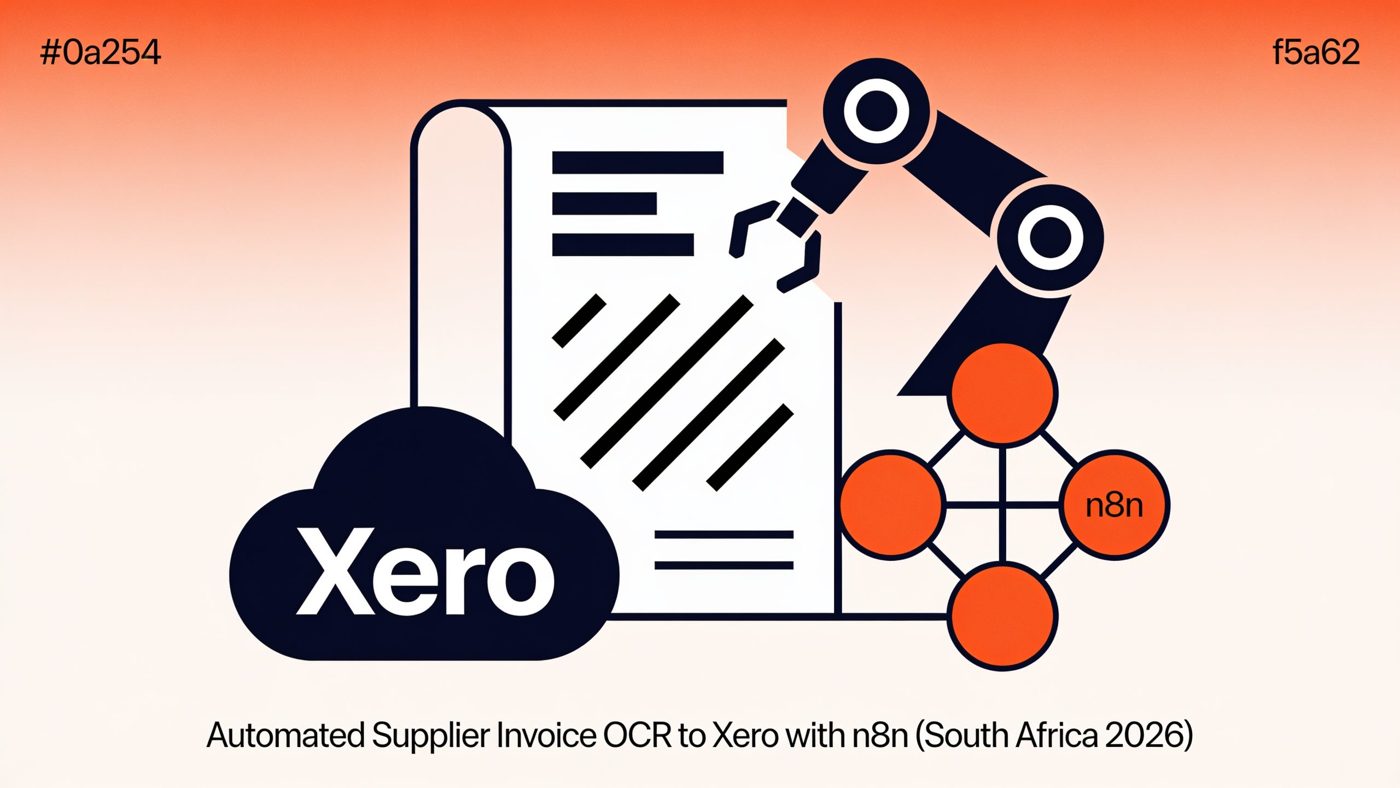
By connecting an incoming email inbox to n8n, an open workflow automation platform, businesses can parse supplier attachments automatically upon arrival. When a vendor emails an invoice, n8n detects the attached PDF, extracts the raw document, and routes it through an optical character recognition (OCR) engine or AI extraction node.
An optimized n8n Xero invoice workflow converts unstructured vector or image-based PDFs into clean, structured JSON fields. The workflow automatically maps the following extracted attributes directly into Xero’s API endpoints to generate draft bills instantly:
- Vendor Identity: Supplier name and SARS Tax/VAT registration number.
- Document Metadata: Invoice number, issue date, and calculated due date.
- Financial Breakdown: Line-item descriptions, net subtotal, 15% South African VAT amount, and grand total.
Once mapped, the workflow posts a draft bill into Xero (set to Awaiting Approval) and attaches the original supplier PDF directly to the transaction record. This end-to-end SME invoice parsing automation transforms incoming emails into organized accounting entries without requiring manual intervention, laying the groundwork for dependable automated receipt processing Xero workflows across growing local teams. For businesses scaling up operations, implementing supplier invoice ocr xero n8n south africa workflows ensures high document throughput without expanding back-office headcount.
Step-by-Step Architecture: Ingestion, Extraction, Validation, and Accounting Post
Building a production-ready pipeline for supplier invoice ocr xero n8n south africa operations requires four distinct structural stages:
- Attachment Ingestion: An n8n workflow monitors your accounts payable inbox (such as [email protected]) using an IMAP or Google Workspace trigger. The moment an incoming email contains a PDF or image attachment, n8n isolates the document in memory to maintain security compliance.
- Text Extraction & Data Parsing: n8n routes the binary file to an OCR engine or vision-capable node. The system converts raw document visuals into clean JSON data, accurately isolating line items, invoice numbers, issue dates, sub-totals, and vendor details.
- Validation & SARS Compliance Rules: Before pushing data downstream, logical conditional nodes verify that line-item sums match the final invoice total and confirm the calculation of South Africa’s standard 15% VAT. If an invoice fails validation—due to a missing vendor tax number or a rounding discrepancy—the workflow routes it to a Slack or Microsoft Teams exception queue. You can learn more about configuring these custom safety controls through our workflow automation services.
- Posting to Xero: Once validated, n8n communicates directly with the Xero API to generate a draft bill under “Awaiting Approval” while attaching the original supplier PDF directly to the transaction record for full audit visibility.
Quantifiable Business Outcomes: Admin Hours Saved and Tax Compliance Improvements
Deploying automated document processing yields immediate operational returns for South African operations managers and finance teams:
- Drastic Reduction in Processing Overhead: Manual invoice entry averages 5 to 8 minutes per document. Automated OCR extraction completes the same task in under 10 seconds. For example, a Durban-based logistics provider processing 400 monthly vendor bills reduced accounts payable processing time by over 45 hours every month, reallocating finance personnel to strategic supplier negotiations and cash flow planning.
- Audit-Ready SARS Compliance: Validating input VAT claims during SARS audits requires precise vendor VAT registration numbers and full supporting documentation. Automated workflows extract tax figures accurately while attaching the source PDF directly to Xero, building an unalterable, audit-ready paper trail.
- Cost Efficiency at Scale: Enterprise accounts payable platforms typically charge per-user subscriptions or per-document processing fees. Using n8n allows growing businesses to scale transaction volumes without incurring exponential software licensing costs.
To evaluate how automated workflows fit into your current operational stack, explore our business automation guides for practical implementation strategies.
Ready to Take the Next Step?
Not sure where to start with automation? We offer a free automation audit for South African businesses — no jargon, no hard sell. Book your free consultation and find out exactly where automation can save you time and money.
Get in touch with GrowthStart — no obligation, no jargon. Just a straightforward conversation about what automation can do for your business.